
Before a people can be controlled physically, they have to be attacked mentally.
That is menticide.

The term was popularized by Dutch psychiatrist Joost Meerloo, who used it to describe the systematic destruction of a person’s mind through fear, propaganda, coercion, and psychological manipulation. Although Meerloo was writing about totalitarian governments, the concept reaches far beyond dictatorships. History shows that psychological warfare has long been one of the most effective tools of conquest, colonization, and oppression. When it comes to my people, menticide did not just happen once. It has been happening for centuries.
Slavery was not only a physical system. It was a mental one. It did not just steal labor; it attempted to steal language, names, family, culture, spirituality, history, identity, and memory. Enslaved Africans were told they were no longer African. They were told they were property. African spiritual traditions were often portrayed as primitive or demonic while European Christianity was presented as the only legitimate path to God. Their features were called ugly. Their intelligence was questioned. Their pain was dismissed. Their resistance was criminalized. The objective was never simply obedience. It was to reshape how an entire people understood themselves.
This strategy was not unique to Africans. Indigenous peoples throughout the New World also endured deliberate efforts to erase their languages, ceremonies, family structures, and cultural identities through forced assimilation, boarding schools, land theft, and religious conversion. Although these histories are different and should never be treated as identical, they reveal a pattern that has accompanied colonization throughout history. Before people are conquered physically, they are often taught to forget who they were. That kind of violence does not disappear just because chains are removed. It evolves.
One of the most powerful forms of menticide has been the steady feeding of negative images. My people have been portrayed as dangerous, lazy, hypersexual, ignorant, criminal, angry, broken, and naturally inferior. These images were not accidental. They helped justify slavery, segregation, and police brutality. They helped justify poverty, exclusion, and neglect as well.
If the world can be convinced that we are the problem, then the systems harming us never have to be held accountable.
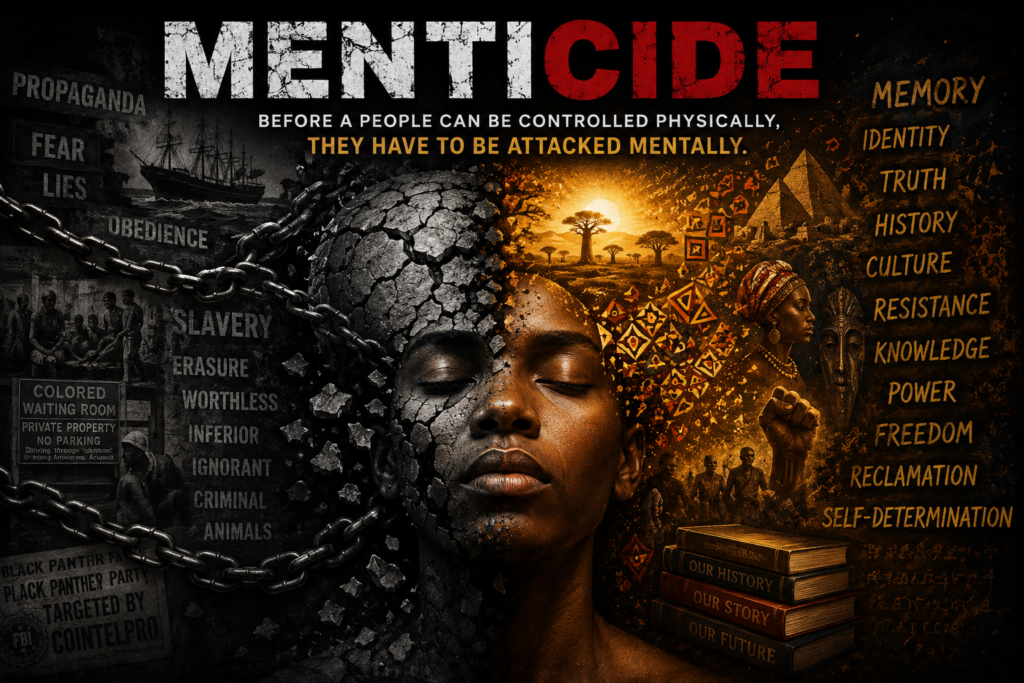
That is the trick.
The media has played its part beautifully. Film, television, music, news, and social media have all helped shape how we are seen. Representation matters, but repetition matters even more. When the same stereotypes are repeated long enough, they stop sounding like lies and start feeling like identity. They influence how the world sees us, but more dangerously, they can influence how we begin to see ourselves.

The education system has also played a role in menticide, often not by teaching outright lies, but by leaving entire chapters of history untold. Too many of our children are taught history as if Black life began with slavery and ended with the Civil Rights Movement. They learn about chains before kingdoms. They learn about oppression before innovation. They learn about Martin and Rosa, maybe Harriet if the teacher has extra time, and then the curriculum moves on as though our story is nothing more than a footnote in someone else’s country. That is not education. That is erasure with a lesson plan.
A child who never learns who they come from may struggle to imagine who they can become. When our children are not taught about African civilizations, Black inventors, Black resistance, Black writers, Black entrepreneurs, Black scientists, Black spirituality, Black language, Black survival, and Black brilliance, they are being robbed of an inheritance. Not money. Memory.
The criminal justice system has also been one of the greatest tools of menticide. Our people have been over-policed, overcharged, over-sentenced, and over-surveilled while being told the problem is crime. But what happens to a community when the law rarely feels like protection? What happens when our children grow up seeing police as a threat before they ever see them as help? What happens when the image of Blackness and criminality is repeated so often that even innocent people are treated like suspects? It does something to the mind. It teaches fear, suspicion, and survival as a permanent state of being. That is not just injustice. That is psychological conditioning.
Then there is the economic system. We have been locked out, pushed out, priced out, redlined, underpaid, underfunded, and then blamed for not building wealth fast enough. Whole communities were stripped of resources, denied access, flooded with exploitation, and then judged for struggling. You cannot break someone’s legs and then mock them for limping.
Economic menticide convinces people that poverty is a personal failure instead of a designed outcome. It tells us we are lazy while ignoring stolen labor. It tells us to pull ourselves up by our bootstraps in a country that spent centuries stealing the boots.
The most dangerous thing about menticide is that it does not require someone to consciously hate us forever. Eventually, the system can step back because the programming begins repeating itself. Distorted ideas about Black intelligence, Black beauty, Black success, Black spirituality, and Black worth become embedded in culture. They are passed through media, classrooms, workplaces, churches, political rhetoric, and sometimes even within our own communities. That is how psychological warfare survives long after the people who designed it are gone.
That shame is part of the programming because menticide does not only work when someone else hates you. It works best when you begin questioning yourself instead of questioning the systems that taught you to see yourself through a distorted lens. It convinces us that the problem is our identity instead of the conditions imposed upon it.
That is why reclaiming history is about more than memorizing dates or celebrating heritage during one month of the year. It is about recovering memory. It is about understanding what was taken, what survived, and what still belongs to us. A people who know who they are become much harder to manipulate than a people who have been taught to forget.