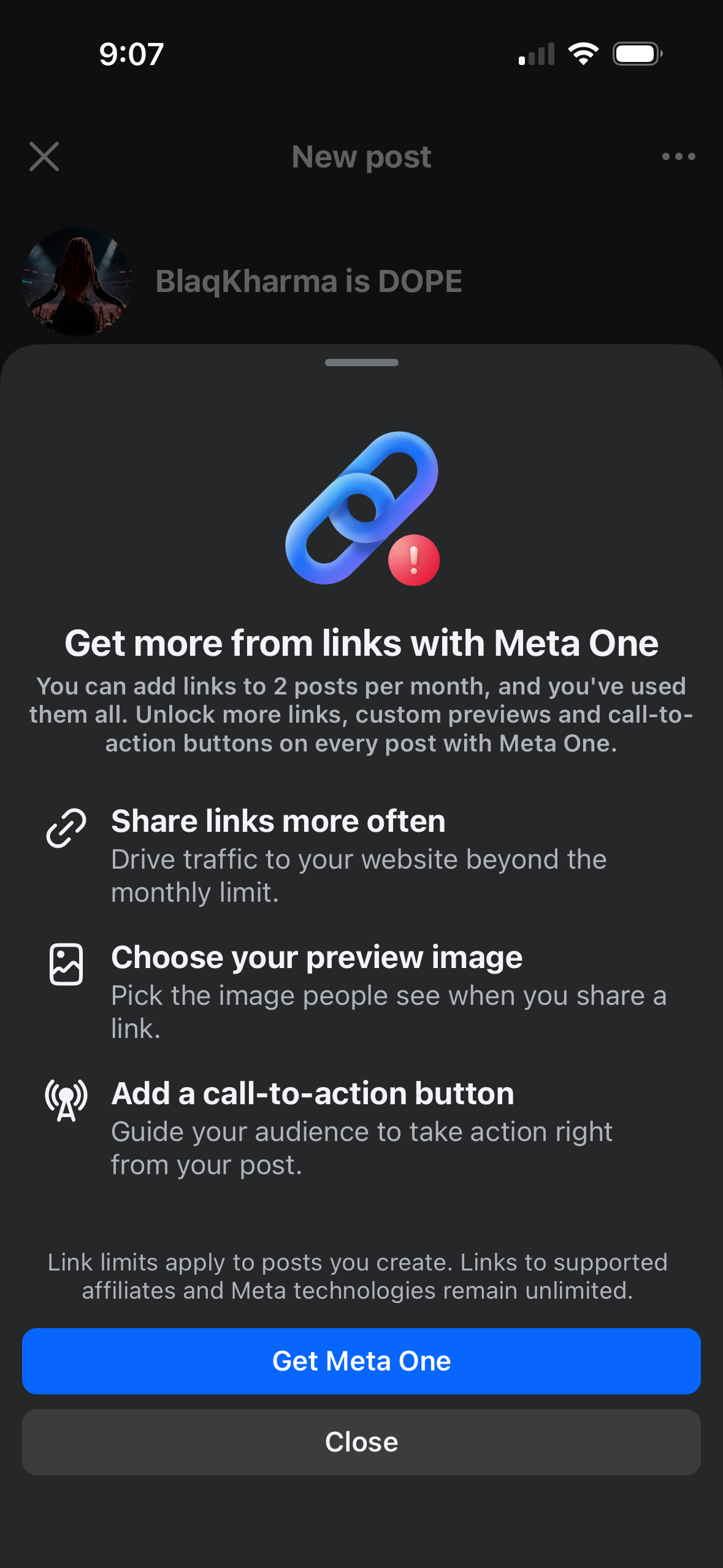
When I opened Facebook to share one of my latest articles, I expected to do what I’ve done for years: write a caption, paste my link, and hit publish. Instead, Facebook stopped me with a message that honestly made me wonder whether I had misunderstood what I was reading. According to Meta, I had reached my monthly limit on posting links and would need to subscribe to Meta One to share links unlimited. I stared at the screen for a second, thinking there had to be some mistake because sharing a hyperlink is one of the most basic functions of the internet. Since when did that become a premium feature?

I understand that companies need to make money. Facebook is not a charity, and I do not expect Meta to operate without looking for new revenue streams. What I do not understand is why one of the oldest and most fundamental features of the web has suddenly become something creators are expected to pay for. I was not asking Facebook to advertise my post or boost it to thousands of strangers. I was not requesting analytics or some advanced business feature. I simply wanted to tell the people who already follow me that I had published something new on my own website.
The more I thought about it, the more irritated I became. It was not even about the subscription price. It was about the principle behind it. Social media was originally sold to us as a way to connect with people and share what we created. Now it feels like every few months another basic function gets tucked behind a paywall while algorithms make it harder and harder to reach the very audience you spent years building.
That is the part that feels especially insulting. Writers, artists, musicians, small business owners, and independent creators helped make these platforms valuable. We posted our work, invited people to follow our pages, joined conversations, built communities, and gave people reasons to open the app. Our ideas, pictures, jokes, arguments, grief, celebrations, and creativity kept people scrolling. Meta benefited from all of it, and now it wants to charge us for the ability to direct our own followers somewhere outside of Facebook.
At some point, this stops feeling like innovation and starts feeling like extraction. I already struggle to care about most social media platforms because so many of them have turned into a constant stream of nothingness. The same recycled opinions. The same manufactured outrage. The same ads, suggested posts, sponsored content, and videos nobody asked to see. You can follow someone intentionally and still barely see what they post because the algorithm has decided that keeping you distracted is more profitable than showing you what you actually chose. Now, on top of that, I am being told there may be a price attached to sharing my own work. Listen, Mark, FUKK YOU HARD IN THE PUSSY!
This has now created this strange feeling of being pushed out of something I barely wanted to remain part of in the first place. I have never loved the direction social media has taken, but I tolerated it because it was still one of the few ways to tell people where my work lives. If even that basic function is being restricted, then what exactly is the point?
I knew subscriptions were going to become a larger part of the internet. We all watched it happen. Every platform developed a premium tier. Every service began separating ordinary users from paying users. Every company found a way to turn convenience into a monthly charge. But at what point do we say enough?
How many basic functions can be stripped away, repackaged, and sold back to us before we admit that this is the epitome of capitalism? Not capitalism as a distant theory, but capitalism as an everyday experience: taking something people already use, limiting access to it, creating frustration, and then selling the solution.
It is disturbing because there is no natural stopping point. Once basic participation becomes monetized, everything is fair game. First it is verification. Then it is reach. Then it is links. Next, it may be visibility, identity, access, or the right to communicate without being buried unless you pay. At this rate, it feels like the next subscription will be for independent thought.
And no, Facebook is not getting my money for verification. I am not submitting identification so a corporation can certify that I am myself. I am not paying for the privilege of posting a link to a website I own. If Meta believes I am going to purchase access to functions that helped make Facebook useful in the first place, it has seriously misunderstood how little attachment I have left to the platform.
I would sooner build my own network. Maybe that sounds dramatic, but I do not think it is. At some point, people are going to get tired of being treated like both the product and the customer. We are expected to create the content, generate the engagement, bring the audience, hand over our information, tolerate the advertising, and then pay for basic access on top of it. That is not community. That is containment.
The internet once felt like a place where people could build something of their own. Now it increasingly feels like a collection of gated spaces owned by corporations determined to charge admission to rooms users helped construct.
A hyperlink should not be a luxury. Sharing your own work should not require permission from a subscription tier. And participating online should not feel like agreeing to another bill every time a company decides it has not extracted enough from you yet. Eventually, people will stop asking how much more they are willing to pay and start asking why they are still there at all.