I keep seeing the same sick pattern, and I am done pretending it is normal. On social media, especially TikTok, domestic violence against Black women is being served up as entertainment.

What makes it even more twisted is the way these same platforms pretend to protect us. We censor basic words like “murder” and “death.” We bend our language into strange shapes to keep a video from being taken down or shadow-banned. You cannot say certain words plainly even when you are talking about real events, real loss, and real grief. But in that same scroll, you can open the app and watch a Black woman being abused in real time. You can watch the arguments, the intimidation, and the breakdowns. You can watch a whole domestic violence situation unfold live. No blur, filter, or warning. Not only is it rarely flagged. It is pushed. It is boosted. It is fed to us through the algorithm, like it is just another trend.
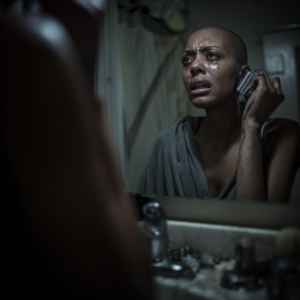 I am not a hater. I do not wake up hoping other women lose their platforms or their bag. But I will be honest about what I see. There are creators whose entire online existence is built on chaos and crisis. One of the most obvious examples is E. Kane. If you have been online long enough, you already know the name. You do not even have to follow her to know her story. There is constant conflict with her child’s father. There are screaming matches on live. There are nasty interactions with strangers on the internet. There are moments where she shaves her head in front of an audience every time she hits a breaking point, like body shock has become a coping mechanism and a content strategy at the same time. The sad part is, she is not the only one. She is just the most visible.
The part that really disturbs me is that I do not follow her at all. I have never hit follow on her page. I value my mental health and my peace too much. I am a person who feels everything on a strong intensity level. I have Borderline Personality Disorder. My nervous system is already carrying enough. I have no desire to invite extra chaos into my body or my mind. Yet somehow, her content still shows up on my feed. Somebody is screen recording a live and reposting it. Somebody is stitching her video and adding commentary. Somebody is breaking down her latest domestic violence incident or meltdown like they are recapping a reality show.
 I am not looking for this woman’s content. I am actively avoiding it. But the algorithm has decided that her story is something I need to see. This is where the pattern becomes clear. Domestic violence involving Black women is being turned into a show, a plot, a cycle that people expect. When the victim is a Black woman, the situation is treated less like an emergency and more like another season of a messy series. People talk about these women the way they talk about characters on television. They dissect their choices. They mock their trauma. They replay the worst moments of their lives as if they are highlight reels.
And it is not only natural-born Black women. Look at the recent case of Girl Lala, a Black trans woman whose last call to emergency dispatch was recorded and circulated all over social media. You could hear this woman’s panic and her final moments with the operator while scrolling the same platform that serves dance challenges and shopping haul videos. People did not just share the news that she had been killed. They shared the actual audio of one of the last conversations of her life. That audio was replayed, analyzed, reacted to, and chewed up for content. That is not awareness. That is not advocacy. That is the consumption of trauma.
If you watch how this works long enough, you see what the algorithm really values. It is not safety, healing, or community care. It is engagement. It is watch time. It is comments and stitches and duets. The app loves anything that makes people stop and stare. Domestic violence happens to do that, especially when the people in the video are Black and already stereotyped as dramatic, loud, and built for chaos.
There is also the old story sitting under all of this. Black pain has always been turned into something for the public to consume. There was a time when photographs of lynchings were printed on postcards. There was a time when television executives built whole careers off the image of the angry Black woman. Now we are in a time where apps profit from our breakdowns in real time. The technology has changed, but the value system has not. Our suffering still sells.
On top of that, you have the way these platforms practice what I call selective censorship. Say the word “murder” clearly in your caption and you risk your video being taken down. Type “death” without censoring it and your reach might get cut. We are told this is to protect people from harmful content. But where is that same energy when a Black woman is being hit on camera? Where is that energy when a Black trans woman’s last phone call is floating around the internet for strangers to argue over?
If these platforms can build systems that recognize the songs we like, the looks we gravitate toward, and the niche we belong in, they can also build systems that slow down and contain the spread of real-world violence and trauma. They can hire people and design tools that understand context, not just words. They choose not to prioritize that work because it does not serve their bottom line the way outrage and spectacle do.
The wild part is that the app does not care that I am trying to protect myself. The algorithm is not listening when I say I do not want to see this. It does not matter how many times I hit “not interested.” This bullshit still finds a way to my feed. Millions of people cannot look away. As long as they keep watching, as long as they keep commenting, the machine keeps pushing the story, no matter who gets retraumatized along the way.
So what do we do with this? I do not have a simple answer. I am not going to pretend that logging off and touching grass will fix a system that is built to feed on our worst moments. But I know there are a few things I can control. I can decide where I spend my time online. I can block and mute aggressively. I can hit “not interested” every single time the app tries to feed me somebody else’s abuse as entertainment. I can choose to step away from certain platforms when they become a threat to my peace instead of a tool for connection.
And I can use my own space, like this one, to say clearly that what is happening is not normal and it is not okay. Domestic violence involving Black women is not content. It is not a trend. It is not a storyline that should make us eager to see what happens next. These are real lives, real bodies, and real nervous systems trying to survive.
If the platforms will not draw a line, then I will. I will not feed my spirit with somebody else’s suffering. I will not pretend that our pain going viral is the same thing as our stories being heard. I will protect my peace and tell the truth about what I see. And what I see is this: when it comes to Black women and Black trans women, these apps will censor our words before they censor our wounds.